
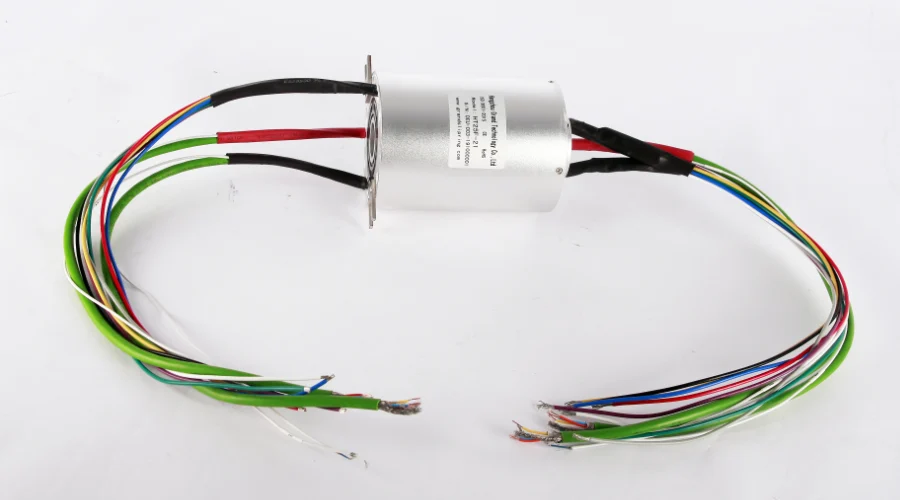
Many people first know slip rings on continuously rotating equipment. The equipment keeps rotating, but power and signals cannot be interrupted. If the cable rotates with the equipment, it will quickly become tangled, and the rotation angle will be limited.
At this point, a device is needed to solve the problem of “power and signal transmission during rotation”—this is the slip ring.
Slip rings are also called conductive slip rings, electrical slip rings, current collector rings. In different industries, they are also called rotary electrical interfaces, electrical rotary connectors, etc. Essentially, it is an electrical connection device for rotating equipment, its main function being to continuously transmit power, current, and various electrical signals between two relatively moving mechanisms.
The biggest difference between slip rings and ordinary cables is that cables are more suitable for fixed connections, while slip rings solve the problem of “powering while rotating.” Therefore, as long as equipment rotates continuously and requires a stable electrical connection, slip rings have an application space.
How do a slip ring work?
The working principle of a slip ring is not complicated, but making it well is not easy.
A basic conductive slip ring typically consists of a rotating part and a stationary part. The rotating part houses the conductive ring, and the stationary part houses the brush filaments or brush bundles. When the equipment rotates, the conductive ring rotates with it, while the brush filaments remain stationary, maintaining continuous contact with the conductive ring surface.
Current or electrical signals enter from the stationary end, pass through the contact points between the brush filaments and the conductive ring, and are then transmitted to the rotating end.
Simply put, it transforms a fixed cable connection that is easily broken or tangled into a continuously rotating sliding electrical contact method.
Here is a crucial point: the brush filaments cannot be pressed too loosely or too tightly.
Insufficient pressure can lead to unstable contact during rotation, potentially causing momentary circuit breaks, signal fluctuations, or increased electrical noise; excessive pressure increases friction and wear, affecting the slip ring’s lifespan. Therefore, the brush filament material, elasticity, contact pressure, and the surface finish of the conductive ring all directly affect the slip ring’s performance.
What are the main components of a slip ring?
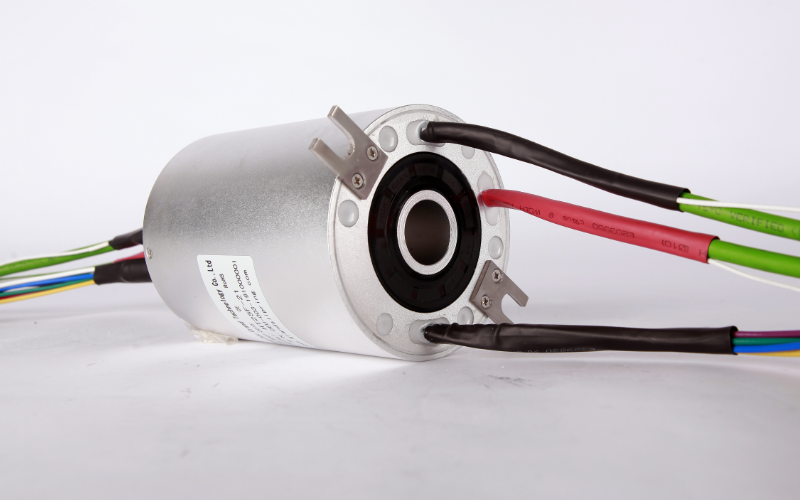
Structurally, a common electrical slip ring mainly includes a conductive ring, bristles, a high-precision bearing, insulating components, a support structure, and a housing.
The conductive ring is the core component of the rotating contact, responsible for providing a stable current or signal transmission path. Its material, surface treatment, dimensional accuracy, and machining quality all affect contact performance.
The bristles are responsible for maintaining elastic contact with the conductive ring. In actual design, different bristle materials and structures are selected based on the current magnitude, signal type, rotational speed, and lifespan requirements.
The bearing supports the rotating parts, enabling the entire assembly to rotate smoothly. For high-speed slip rings, the bearing’s precision, fit, and operating conditions all affect the final performance.
The insulating material is responsible for reliably isolating different circuits. Especially when multiple power supplies and weak signals are transmitted simultaneously, the insulation design directly affects the product’s safety and signal stability.
In addition, there are auxiliary components such as the housing, bracket, sealing structure, leads, and connectors. These parts cannot be ignored when actually applied to equipment, as the slip ring ultimately faces complete mechanical, electrical, and environmental conditions.
Does a slip ring only come in one shape?
No.
Many people, upon seeing a slip ring, habitually assume it’s a small, cylindrical component. In reality, slip rings don’t have a fixed shape; their structure is typically designed based on installation space and usage requirements.
Common products include cap-type slip rings, through-hole slip rings, disc slip rings, miniature slip rings, and combination slip rings.
Through-hole slip rings have a central through-hole, allowing shafts, air pipes, cables, or other mechanical structures to pass through, making them suitable for equipment requiring a central shaft.
Cap-type slip rings are relatively compact and suitable for rotating mechanisms with limited installation space.
Disc slip rings are axially arranged, offering advantages in situations with limited axial space but relatively ample radial space.
In addition, actual projects often encounter customized structures such as those with connectors, flanges, special housings, extra-large through-holes, and multi-channel hybrid transmission.
Therefore, “slip ring” should be understood as a product category rather than a specific fixed structure. The specific form used depends on the mechanical structure and electrical requirements of the equipment itself.
Can slip rings only transmit current?
No.
This is a common misunderstanding in practical applications.
Early understanding of slip rings focused primarily on power transmission. However, with the development of rotating systems such as automated equipment, robots, radar, pan-tilt units, and medical equipment, the tasks performed by slip rings have become increasingly complex.
Besides power, they can also transmit switching signals, analog signals, encoder signals, control signals, network communication signals, and other data.
For more demanding equipment, optoelectronic combination slip rings are used, integrating electrical, electrical, and optical signals into a single rotating connection component. For high-speed data transmission or long-distance, high-bandwidth transmission, fiber optic rotating connection technology may be further employed.
Therefore, when discussing “slip rings” today, it’s no longer sufficient to understand them simply as a current transmission component.
More accurately, it’s a comprehensive transmission interface in rotating equipment.
Why do slip rings wear?
Any mechanical sliding contact will inevitably involve wear.
During equipment operation, the slip ring rotates continuously while the brush bristles remain stationary, creating relative motion between them. Over time, friction develops on the contact surfaces, affecting electrical performance and lifespan.
However, the lifespan of a slip ring is not simply determined by the number of revolutions.
Rotation speed, current magnitude, signal type, contact materials, contact pressure, temperature rise, operating environment, and manufacturing/assembly precision all influence the actual lifespan.
For example, at high speeds, the effects of mechanical vibration and friction are more pronounced; when transmitting large currents, heat generation at the contact points becomes more significant; and in dusty, humid, or other complex environments, sealing and protective design become crucial factors.
Therefore, the long-term stable operation of a slip ring often depends on the overall structural design, not just a single component.
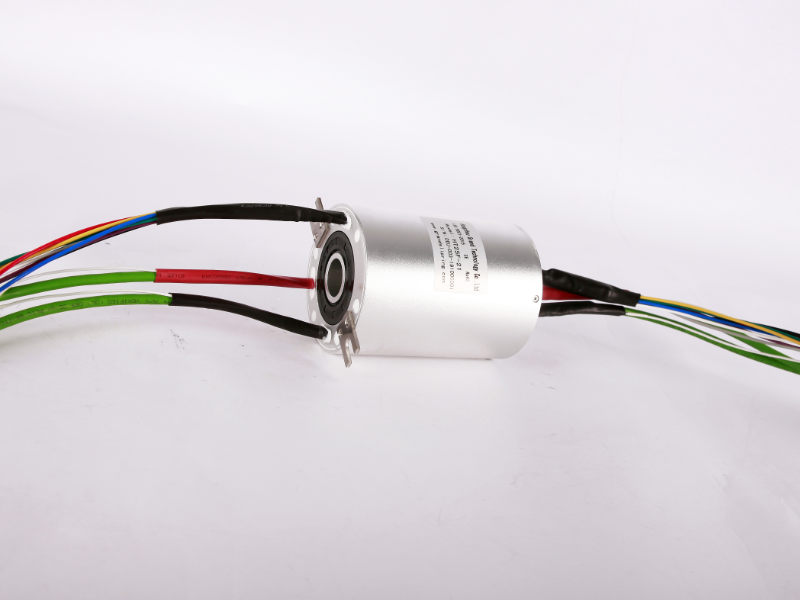
When selecting slip rings, don’t just look at the “number of channels.”
In actual projects, when customers inquire about slip rings, their first question is often, “How many channels do you need?” While the number of channels is important, it’s far from everything.
In actual selection, several aspects generally need to be considered simultaneously.
First, current and voltage. The design of power channels and signal channels is completely different; you can’t simply judge based on the number of lines.
Second, signal type. The design requirements for transmitting ordinary switching signals are different from those for encoder signals or industrial communication signals.
Third, rotational speed. Some equipment rotates at low speeds, while others require long-term high-speed operation; changes in rotational speed directly affect the contact structure and mechanical design.
Fourth, installation dimensions, including outer diameter, axial length, through-hole size, and fixing method. Many slip rings have no inherent performance issues but ultimately cannot be used due to incompatible installation space.
In addition, the direction of rotation, continuous operating time, expected lifespan, operating temperature, humidity, protection level, and the mechanical environment in which the equipment operates must also be considered.
For demanding equipment, further considerations are needed regarding contact resistance, electrical noise, insulation performance, signal crosstalk, and stability under high-speed operation.
Therefore, slip ring selection is not simply about finding a model with the same number of circuits from the product catalog, but rather about matching it to the overall operating conditions of the machine.
Conclusion
The core task of a slip ring can be summarized in one sentence: to enable stable transmission of electricity and signals across a fixed and rotating end, maintaining stability even during continuous rotation.
From basic conductive slip rings to through-hole slip rings, disc slip rings, and then to optoelectronic combination slip rings and other composite rotary connection products, the product form has continuously evolved with equipment requirements.
For equipment manufacturers, slip rings are not standard components that can be selected independently of the application scenario. Only by comprehensively considering factors such as current, signal, rotational speed, space, lifespan, and operating environment can a truly suitable structure and solution be chosen for the equipment.
Therefore, understanding slip rings cannot stop at simply stating that “it is a rotating conductive component.” What truly matters is its design, contact, transmission, and how it maintains stability during long-term operation.
This is also a crucial criterion for judging whether a slip ring is truly suitable for a specific piece of equipment.
See What We Can Do